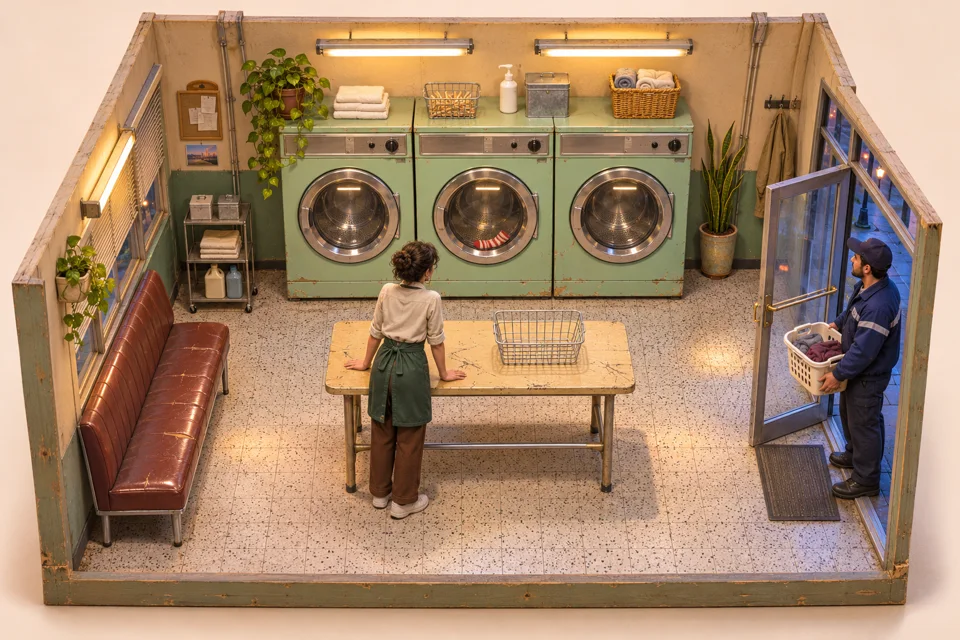
Give the room a deadline
Write down the ordinary action that should end the scene. Here, Bea closes the shop when her sheet shows that every parcel has been collected. Len can leave as soon as he finishes the route. Both could walk out. Each would have to explain an unfinished job. Try the scene without the closing sheet. Bea could leave the sock on the bench and go home immediately. Putting one empty checkbox between her and the end of the shift buys the whole argument.
Put the obstacle where both people can see it
Trace Bea’s path on the set plan: washer, table, basket, bench. Len only has to turn his basket to change from the person who fixes her problem into the person who hands it back. If the driver had to go to the depot for the reveal, the episode would lose the joke of the instant return. On a copy of the floor plan, draw a line for each person. Give every cross a job. Bea goes to the washer to get evidence, then goes to the door for a signature. Len can do both of his jobs from the same spot.
Give a line a second meaning
When Bea asks for a collection receipt, the audience knows exactly how she will win. The scanner pays off that promise. Let the closing-sheet tick land before Len asks for a signature. He is following the same rule she just used, so he can play the delivery straight. For your script, underline the sentence both people would agree with halfway through. Here it is “A parcel with an address gets delivered.” Read that line again after the return. Its meaning has stayed the same, but the person who benefits has changed.
Read it with two people and one object
Use a folded towel for the parcel. Put a chair where the doorway would be and leave it there. Read the middle three beats aloud. If the reader playing Len needs to invent a reason to come back, move the delivery beat earlier, while his hand is still on the basket. Run the exchange again with the scanner sound made by a third hand tapping the table. Try a short pause after the tap and a longer pause after “Duty manager?” Mark which pause gives the person playing Bea time to see what she has done.
Change the room and keep the reversal
Open the blank episode worksheet. Try a rehearsal room: a drummer wants a broken cymbal signed out before rehearsal ends, and the person signing it out is the repair technician who needs the drummer to test it. Write the line that appears to solve the first problem and the action that creates the next. Now hide the final line and give the sheet to someone else. Ask what they expect to happen to the cymbal. If they guess the turn, try giving the repair technician a surprising but entirely ordinary way to ask for the test.
Common mistakes
Cutting to the delivery depot to explain what Len discovers at the door.
Giving Bea long speeches about the rules when one unaddressed parcel lets the audience see the problem.
Adding a third character to accept the parcel. The return is funnier when the same two people have to sign for it.
Questions
Does the door have to be locked in a bottle episode?
No. Len stands in an open doorway for the whole episode. His pickup route and Bea’s closing sheet keep them together. A reason to stay can sustain a scene as well as a physical barrier.
How do I vary the shots in a one-room sitcom?
Start wide enough to see both people. Move close when someone learns something the audience can read, such as the address on Bea’s parcel. Return to the wide shot for the handoff so the viewer can see how little distance the parcel actually travels.
What is the difference between a bottle episode and a clip show?
A bottle episode can tell an entirely new story on a small number of sets. A clip show builds much of its running time from material the audience has seen before. The laundromat script plays straight through on one set.