Vertical Drama Shot List Template (9:16)
By Character App Team · · 10 min read
This is the production handoff between a finished script and connected 9:16 Scenes. Copy the blank fields, study the five-Scene example, and review framing and continuity before filming selected takes.
What belongs in a vertical-drama shot list
A vertical-drama shot list translates story moments into decisions the Director can stage. Each row names the Scene purpose, visible Cast, location, framing, movement, duration, continuity anchor, and exact ending image.
Keep one primary action per Scene. A phone frame rewards close reactions, hands, doors, evidence, and other readable details. Split any action that depends on a wide geography lesson.
- Scene number and purpose: Hook, Suspicion, Reveal, Confrontation, Cliffhanger
- Cast on screen and the approved reference for each person
- Location, time, World Look, wardrobe, and continuity prop
- Shot size, angle, camera movement, and center-safe subject
- Target duration, opening image, ending image, dialogue, and sound cue
- Review note: what must match the prior Scene before this take survives
Copyable blank 9:16 shot-list template
Duplicate the block once per Scene. Write the opening and ending image first; those frames reveal whether the shot changes the Story.
- SCENE: [number] — PURPOSE: [hook / turn / cliffhanger]
- CAST: [name + approved reference] — LOCATION: [settled place]
- CONTINUITY IN: [wardrobe, prop, light, position from prior Scene]
- OPENING IMAGE: [what the viewer understands immediately]
- ACTION: [one visible action] — DIALOGUE: [one short exchange]
- FRAME: [close / medium / insert] — ANGLE: [eye / high / low / over shoulder]
- MOVEMENT: [locked / push / tilt / handheld] — TARGET: [seconds]
- CENTER-SAFE DETAIL: [face, hand, evidence, text, reaction]
- ENDING IMAGE: [the unanswered choice or revelation]
- REVIEW: [identity, wardrobe, prop, staging, readable emotion]
Worked example: The Red File pilot
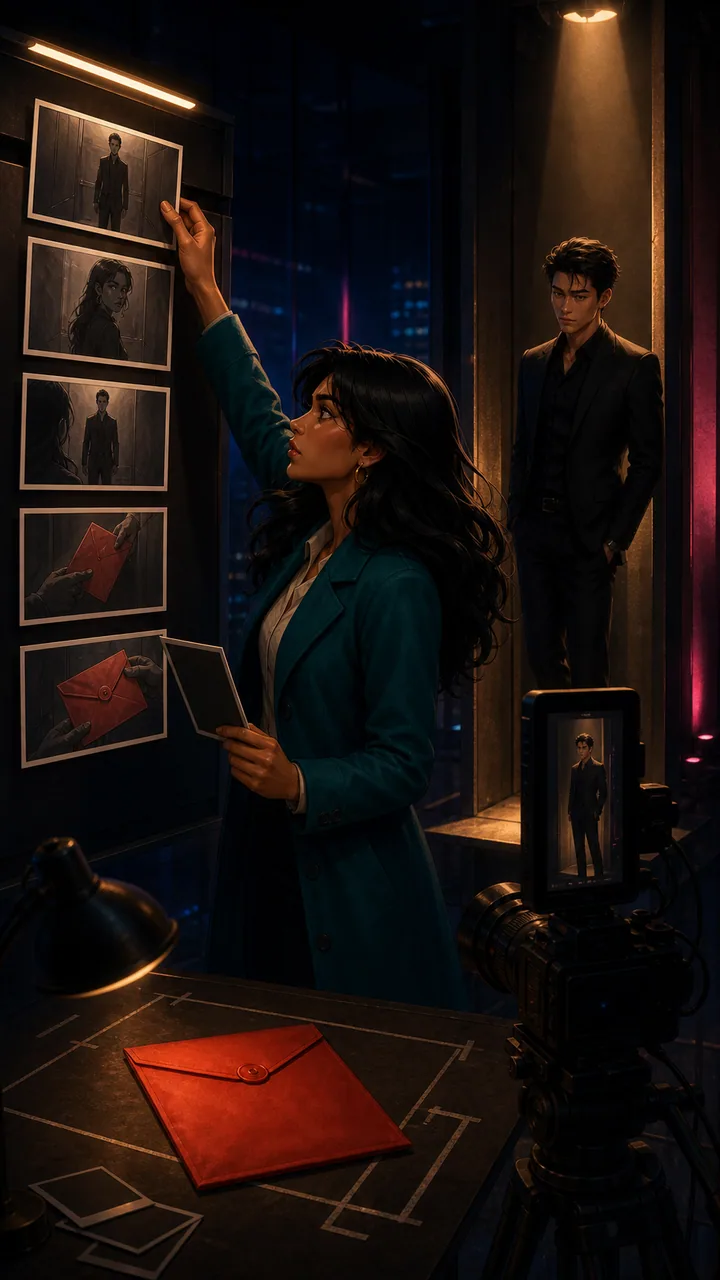
Five Scenes carry one red evidence envelope through a complete minute: it starts as a question, becomes proof, changes hands, and ends as a threat.
- Scene 01 — Hook — 8 seconds: Maya stops the elevator; Adrian holds the envelope in the center. End when he hides it.
- Scene 02 — Suspicion — 10 seconds: over Maya’s shoulder into the mirror. Preserve wardrobe, cold light, and Adrian’s silver watch.
- Scene 03 — Reveal — 12 seconds: insert of Maya pulling the envelope free, then a close reaction. End before she opens it.
- Scene 04 — Confrontation — 14 seconds: centered close two-shot. Maya holds the prop; Adrian blocks the exit. Push toward her question.
- Scene 05 — Cliffhanger — 10 seconds: a photograph slides out. It shows Adrian at her father’s funeral. End as the doors open.
Plan for 9:16 before you draw the Scene
Put the emotional subject near the vertical center, keep essential text and props away from top and bottom overlays, and use close or medium coverage as the default. Test a phone-safe composition at /blog/vertical-drama-video-size-9-16.
Do not treat 9:16 as a crop after production. A horizontal master can lose the hand, glance, or evidence that makes the cliffhanger readable.
Add a continuity checkpoint to every row
A saved Cast reference guides identity, while the prior approved Scene guides immediate state. Say what each reference controls so a beautiful previous frame does not silently replace the person you cast.
Before filming, compare the draft Image with the prior Scene and Bible. References reduce drift; they do not make variation disappear.
- Identity: does the Cast member remain recognizable?
- Wardrobe: are color, silhouette, and condition correct?
- Prop: is it present, in the correct hand, and expected state?
- Space: do doors, windows, and screen direction agree?
- Emotion: does the opening reaction continue the prior ending?
Move the approved list into production
Create a 9:16 Story, attach the recurring Cast and World, then enter one row as one Scene. Draw sequentially, film only the takes that survive review, and approve the exact Studio quote before each paid action.
If the script is not ready, begin with the script template. If recurring people, props, or relationships are unsettled, complete the series Bible first. A shot list should organize decisions, not conceal missing ones.