A Story is the written draft of an Episode — the text plan the Studio generates and you edit before anything gets drawn or filmed. Writing and reviewing a Story costs zero Credits, which makes it the free way to try an idea before you spend a single Lite Image on it.
Go deeperThe glossary: every word a maker needs
Two vocabularies meet in a made show: the product’s nouns — Cast, World, Director, Scene, Take, Clip, Episode, Season — and the craft’s — vertical drama, cold open, cliffhanger, on-model, beat sheet. Each entry below is answer-first, forty to eighty words, anchored so you can link straight to it, with one door into the page that goes deeper. Capitalized words are product nouns; lowercase ones are craft terms the whole industry shares.
- Terms defined
- 40
- Each entry
- 40–80 words
- Capitals mean
- A product noun
- Every term has
- An anchor + a deeper link
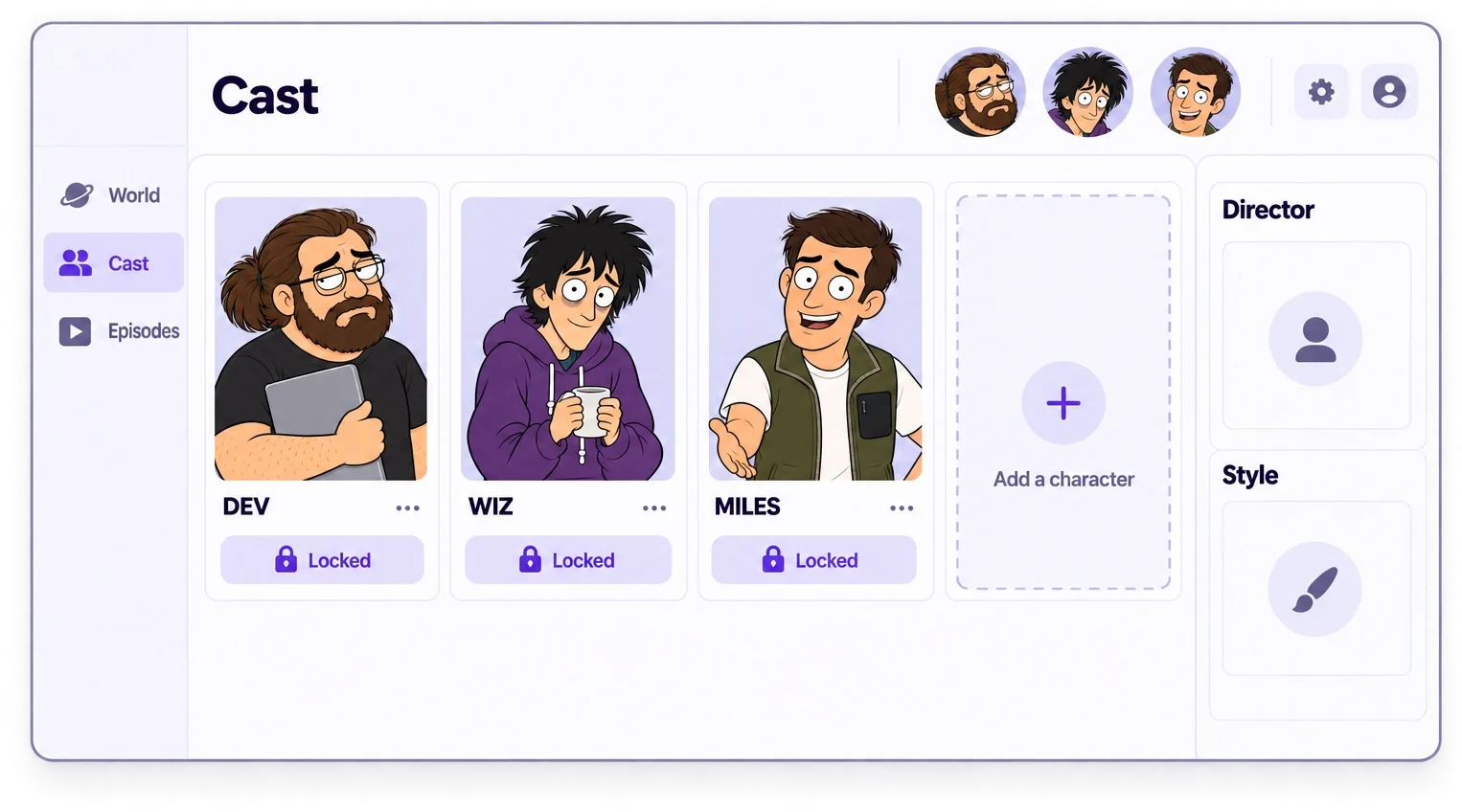
- Studio
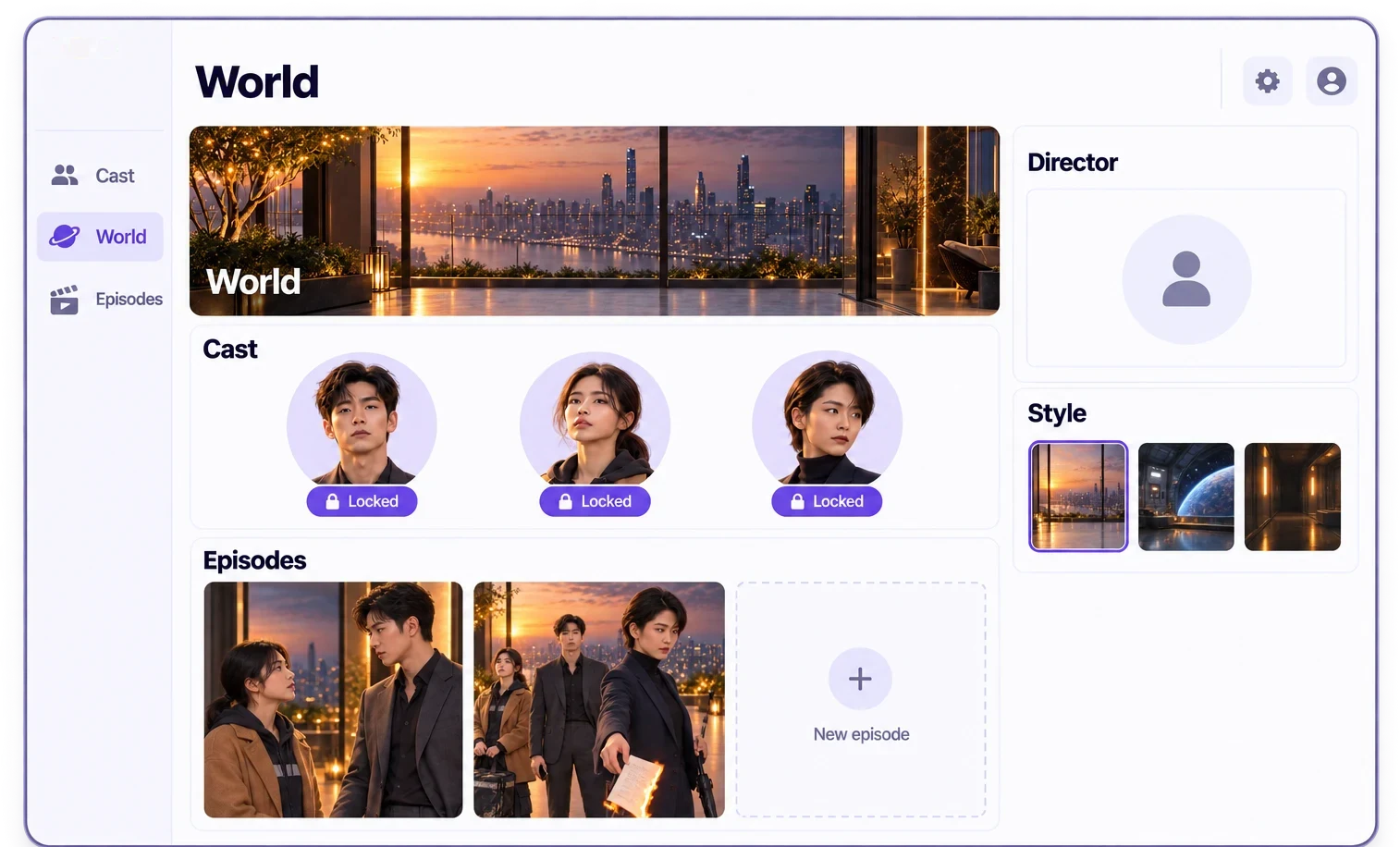
The Studio is the workspace where your show gets made — the surfaces for Cast, World, Director, and Episodes all live in it. When a guide says "in the Studio," it means this whole bench, not one screen. It’s free to enter; the free tier covers a World build, a Character a day, and Lite Images.
Go deeper- World
A World is your show’s persistent setting — the place, its rules, and its memory. It remembers what happened in earlier Episodes, so episode ten can pay off episode two. You build it once; everything inside it — Cast, Scenes, Looks — follows its law. One World build is included in the free tier.
Go deeper- Story World
A Story World is the World treated as a story engine — not just where the show happens, but the rules that keep generating story: who holds grudges, what can go wrong, what the place wants. Two shows can share a setting and still have different Story Worlds.
Go deeper- Cast
The Cast is your show’s recurring company — the saved characters who appear across Episodes, drawn on-model every time. A Cast is built from photos or descriptions and belongs to your account, which is what makes a series a series instead of a pile of clips.
Go deeper- Character
A Character is one member of a Cast — a defined person with a look, a voice, and a way of reacting that persists across Episodes. You can start a Character from a photo or from a written description. The free tier lets you create one Character a day.
Go deeper- Director
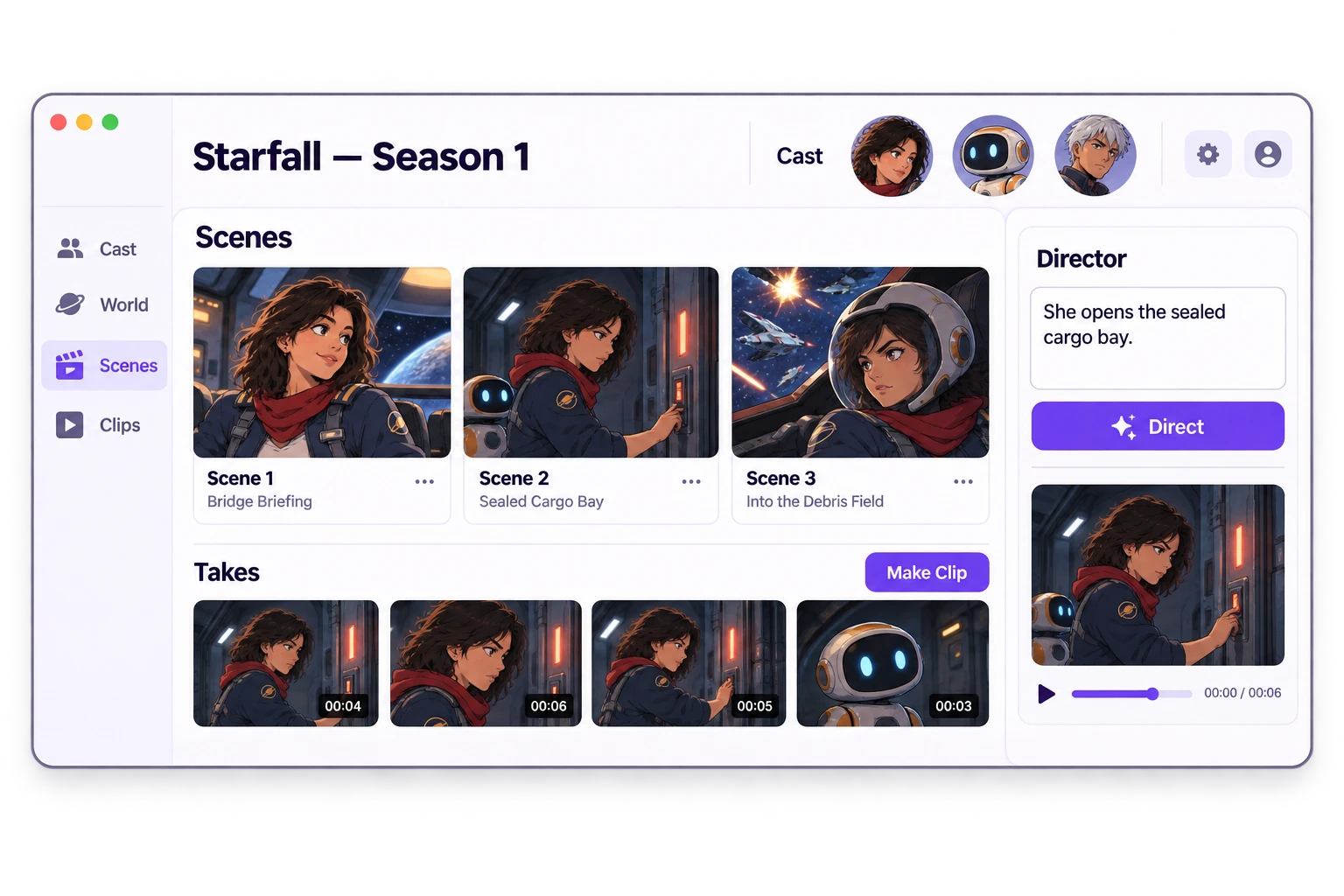
The Director is the surface where you direct: a written line becomes Scenes and Takes, and a Take you don’t like gets retaken rather than accepted. It carries the World’s continuity so your instructions land inside the story, not on top of it. Directing is a job you do, not a filter you apply.
Go deeper- Scene
A Scene is one dramatic unit inside an Episode — one place, one want, one escalation. An Episode is usually a handful of Scenes; a 60-second Episode often has room for only one. Scenes are the level where you direct: shots, Takes, and images all attach to them.
Go deeper- Take
A Take is one attempt at a Clip — the same direction rendered again, or differently, until the moment lands. Retakes are how you direct: you keep the Take that works and discard the rest. Every completed Take is still a real generation, so retake with intention, not on autopilot.
Go deeper- Clip
A Clip is a short generated piece of motion — the unit between a still Scene Image and a finished Episode. Clips are priced per second, and the price rides the press: the Credit cost is shown on the button before you make it. Plans unlock Clip and Film models.
Go deeper- Episode
An Episode is one chapter of your series — a complete hook-escalation-payoff, typically around a minute in the phone-first formats. Episodes share the Cast and the World, so continuity accumulates. A running series is just Episodes that kept going; a Season is the container they run inside.
Go deeper- Season
A Season is a run of Episodes under one arc — the long question that keeps viewers coming back. Planning a Season means deciding what changes by the finale and what each Episode advances. The World remembers across a Season, which is what makes slow-burn payoffs possible.
Go deeper- Film
Film is the finished motion render of your Episode — the moving layer that plans unlock. Where Story drafts and Scene Images are the planning tier, Film is the committed footage, priced deterministically by registry rate times seconds. The exact Credit cost is shown on the press before you make it.
Go deeper- Story
- Storyboard
A Storyboard is the drawn plan of a Scene — the shots laid out as panels before motion happens. In Character App, Storyboard-level planning uses Scene Images: stills that let you check framing, character placement, and the Look before a single Credit goes to a Clip.
Go deeper- Scene Image
A Scene Image is a generated still for a Scene — the planning visual you draw before committing to motion. Lite Scene Images come off the daily free allowance first, which makes them the cheapest way to check whether a Scene is framed right before a Clip spends Credits on it.
Go deeper- Lite Image
A Lite Image is an Image drawn on the free daily meter — currently up to four per UTC day on every account, no card required. Lite Images cover the lightweight draws like Scene Images; they reset daily and don’t roll over, so spending them is the point.
Go deeper- Credits
Credits are the Studio’s unit of spend — every priced press (Images beyond the Lite allowance, Clips, Film) shows its exact Credit cost on the button before you make it. Plans include monthly Credits, wallet Credits roll over while the account is open, and there is no estimate-and-surprise step.
Go deeper- Plan
A Plan is a subscription tier — Starter, Creator, or Pro — that unlocks the moving layer (Clips and Film) and grants monthly Credits. Images and Story pictures never require a Plan; they run on Credits or the daily Lite allowance. Cancel any time; unused wallet Credits roll over.
Go deeper- Look
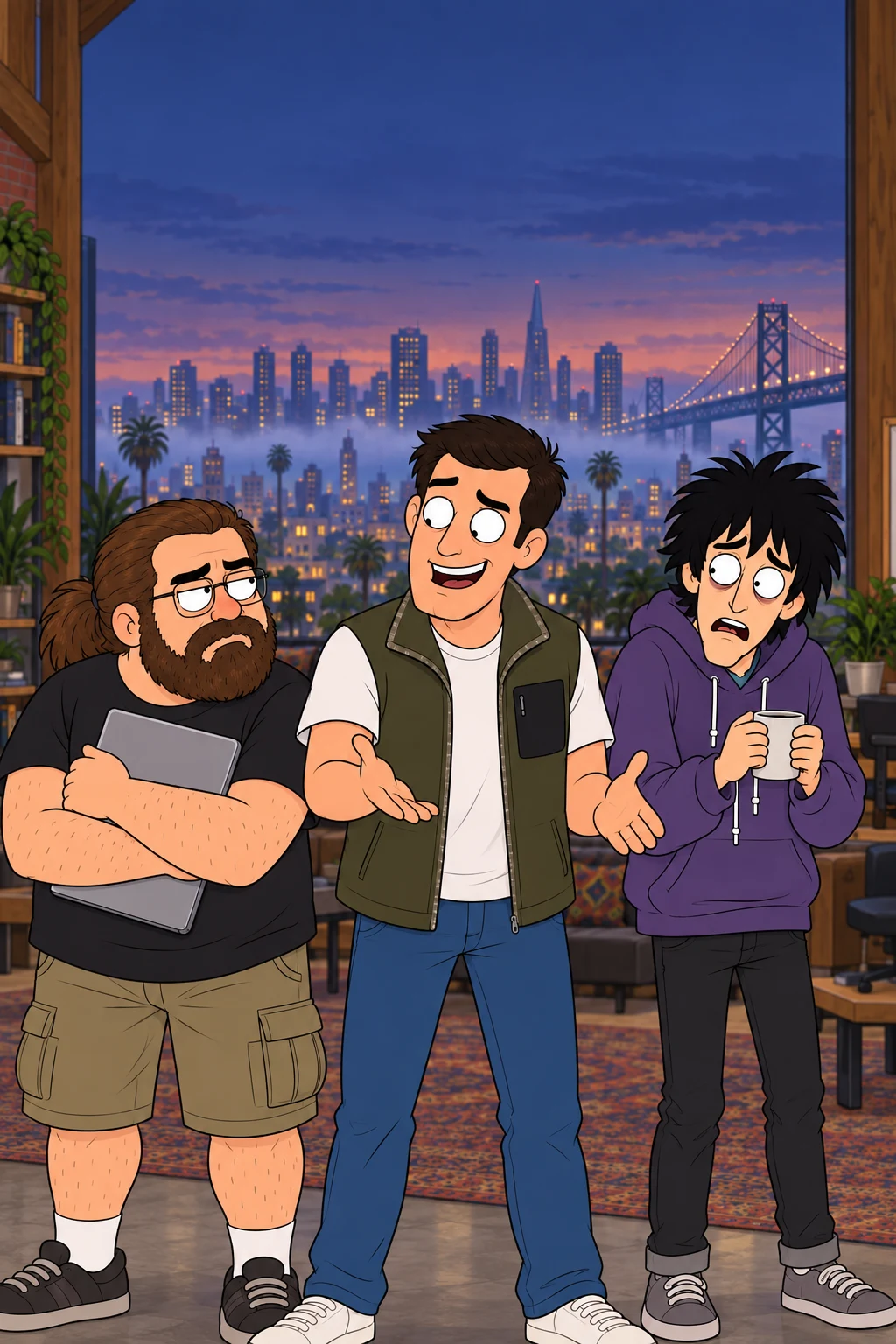
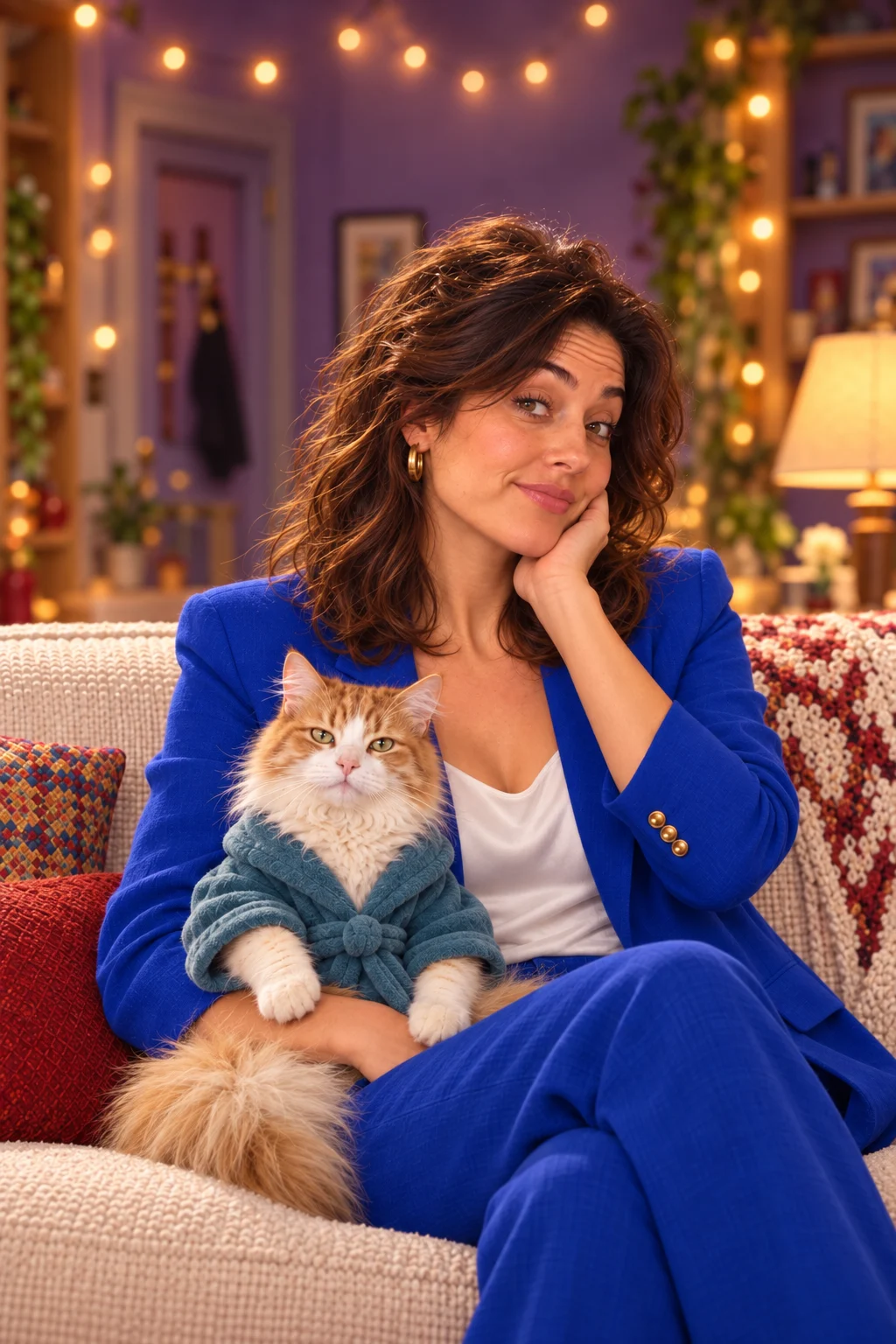
The Look is a World’s visual law — cinematic realism, flat cartoon, cel-shaded anime, inked graphic novel, painterly fantasy, polished 3D. You choose it once and every Image, Cast member, and Episode follows it automatically. The Look is skin; the genre is rules — a World keeps both.
Go deeper- Premise
The Premise is your show in one line — the sentence you type at the door that the World and Cast assemble around. It doesn’t need to be clever, just specific enough to aim: "a laundromat that’s secretly a talent agency" is a premise. Everything downstream is that sentence, kept.
Go deeper- Genre
A genre is the show’s rulebook — not just how it looks but what it does: a sitcom keeps grudges and payoffs, a vertical drama keeps secrets and cliffhangers. Character App’s ten genre spokes each set different writing defaults and a matching Look, so picking a genre picks your story instincts.
Go deeper- Showrunner
A showrunner is the person who runs a series — owns the voice, makes the calls, answers for the whole. In Character App the job is yours: you pick the Cast, write the direction, decide which Take survives. The product’s bet is that "make your own show" should mean literally that.
Go deeper- Vertical drama
Vertical drama is the phone-native serialized genre: 9:16 episodes of one to two minutes, heavy on secrets, betrayals, and cliffhangers — the shape ReelShort and DramaBox sell as catalogs. In Character App it’s a genre you make, not just watch, with the same grammar aimed at your own Cast.
Go deeper- Microdrama
A microdrama is an ultra-short dramatic episode — the sub-two-minute unit vertical drama runs on, built around one escalation and a hard ending beat. The form rewards compression: one place, one want, one turn. Catalog apps sell them by the hundred; a maker writes them one Scene at a time.
Go deeper- Cold open
A cold open is the scene before the titles — the moment that starts inside the story instead of introducing it. In short episodes it’s most of the battle: open on the wrongness already happening, not on setup. If the first shot needs context to matter, the episode started too early.
Go deeper- Cliffhanger
A cliffhanger is an unresolved ending — the episode stops at the moment of maximum tension so the next one is already owed. Vertical drama runs on them, but rotation matters: six identical cliffhangers trains viewers to expect the trick. Mix the laugh, the sting, and the open loop.
Go deeper- On-model
On-model means a character still looks like itself — same face, same costume, same design decisions as its established reference. A Cast that stays on-model across Episodes is what separates a series from a set of related clips. Character App keeps the Cast as a saved asset so each Episode draws it again, not re-invents it.
Go deeper- Character drift
Character drift is the slow slide off-model — episode by episode the face shifts, the costume mutates, until the character is a stranger. It’s the failure mode of clip tools that re-prompt from scratch. The fix is persistence: a saved Cast asset, checked against its own reference each time.
Go deeper- Story bible
A story bible is the document of record for a series — the Cast’s truths, the World’s rules, what has happened and what must stay consistent. In Character App the World plays this role live: continuity isn’t a document you maintain, it’s the thing the Studio remembers for you.
Go deeper- Beat sheet
A beat sheet is the list of turns an episode takes — not dialogue, just the sequence: hook, reveal, escalation, payoff. It’s the fastest way to find a story’s holes before any footage exists. A 60-second Episode has about three beats; a Season has the same skeleton stretched long.
Go deeper- Shot list
A shot list is the planned sequence of shots inside a Scene — wide on the room, medium on her, close on the thing in her hand. A 60-second Episode runs about eight shots of seven seconds each. You don’t need camera language to write one: "close on the letter" is a shot.
Go deeper- 9:16
9:16 is the vertical frame — the phone-first aspect vertical drama and most short-form series ship in. It favors faces, vertical staging, and one thing at a time. Character App produces it natively; it’s the default where the audience watches on a phone. The sister frame is 16:9 widescreen.
Go deeper- 16:9
16:9 is the widescreen frame — the TV and shared-screen shape, better for ensembles and rooms that need horizontal air. Character App treats it as a first-class output beside 9:16, so the same World and Cast can ship vertical Episodes for the feed and wide cuts for the couch.
Go deeper- Hook
The hook is the reason a viewer stays — the image or line in the first five seconds that makes stopping impossible. In a minute-long episode the hook isn’t a title card, it’s the thing already going wrong. Test it muted: if it needs explanation, it isn’t a hook yet.
Go deeper- Payoff
The payoff is the landing of a setup — the laugh, the sting, or the open loop an episode’s last seconds exist to deliver. Pick it before you write the hook, because the payoff tells you what the scene was secretly about. And end on the image of it, not the explanation.
Go deeper- Remix
A remix is rerouting an existing idea — a fandom, a format, a trope — through your own Cast and World until it’s yours. It’s how most personal shows start: not a blank page but a familiar shape bent toward your people. The Cast makes the difference legal and literal.
Go deeper- Ensemble
An ensemble is a Cast designed as a system — each member defined by their friction with the others, so any pairing generates a scene. Workplace comedies are the canonical shape: the straight man, the chaos agent, the boss who shouldn’t be. Build the pairs and the Episodes write themselves.
Go deeper- Season arc
A season arc is the long question a Season answers — what changes between the premiere and the finale. Episodes get hooks; the arc gets a promise. Because the World remembers, an arc can plant in episode two and pay off in episode twelve without a document tracking it.
Go deeper- Running gag
A running gag is a joke that compounds — the same move landing differently each Episode because the audience remembers the last time. It’s the cheapest continuity there is: one detail, endlessly refinanced. A persistent World is what makes it possible — the gag survives because the show remembers it.
Go deeper- Callback
A callback is a later payoff of an earlier detail — the prop from episode one returning in episode nine, loaded with everything that happened since. Callbacks are why continuity matters commercially: they reward the loyal viewer and make the series feel written rather than generated.
Go deeper
TRY THIS
The nouns, in pictures

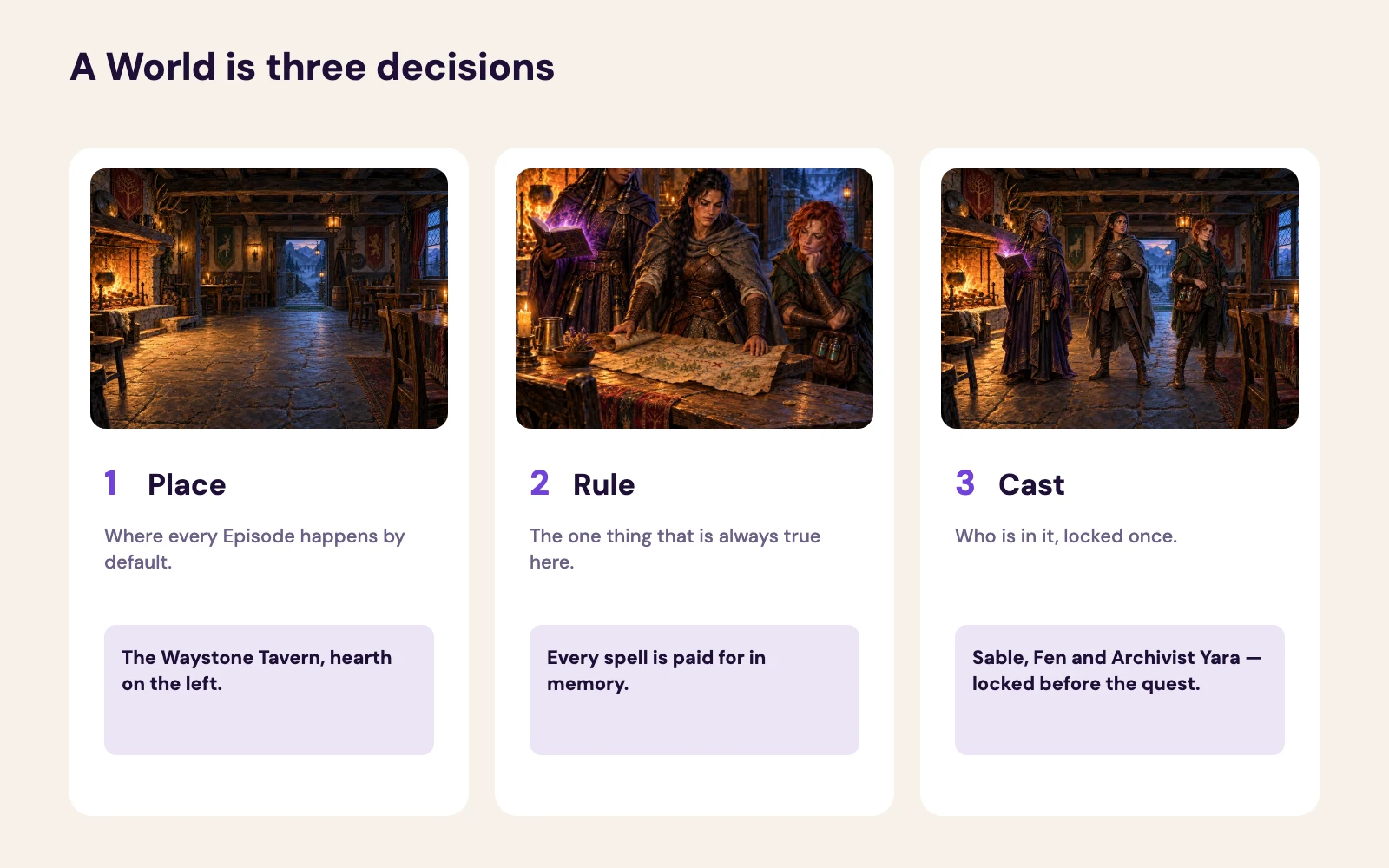
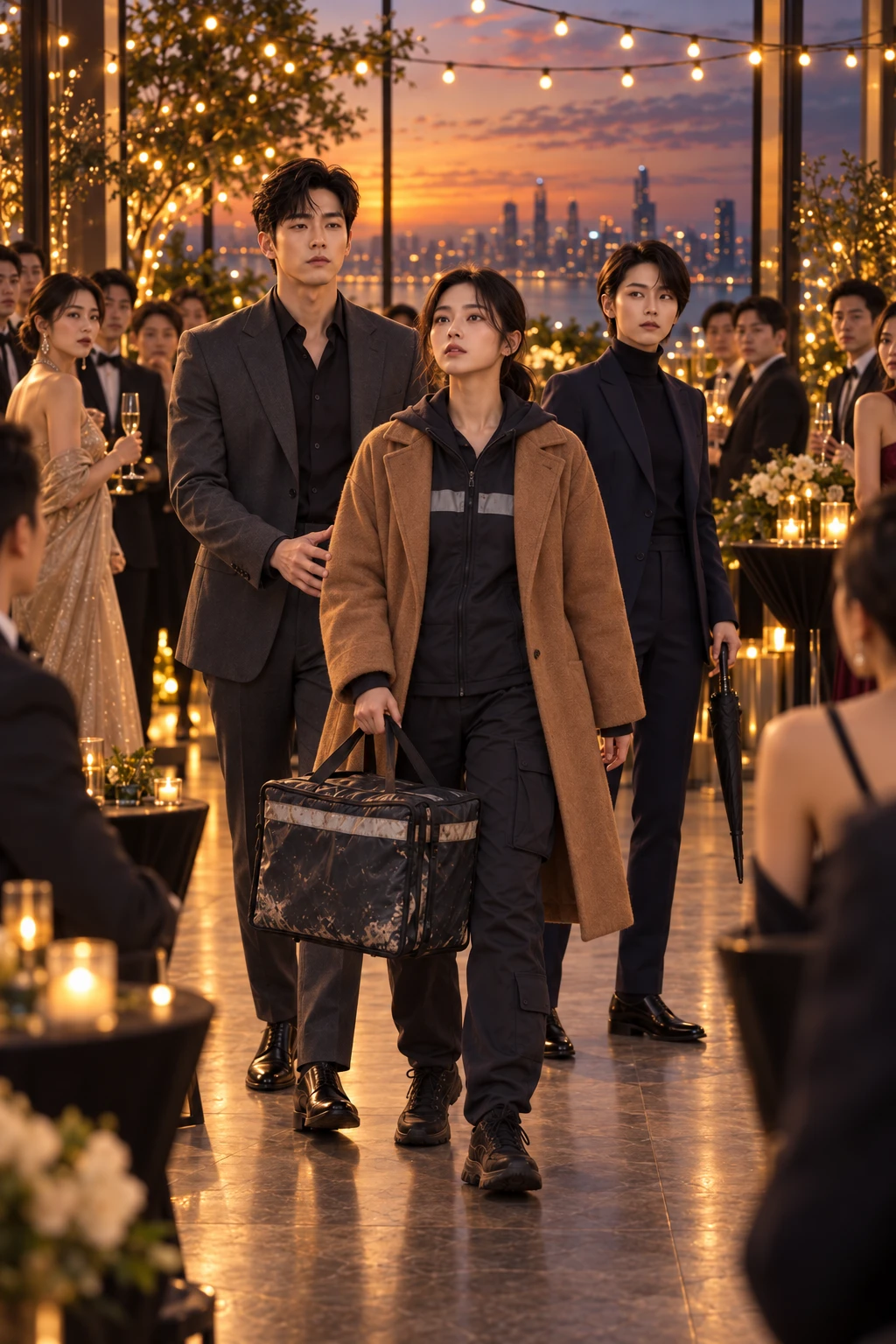
Generated in Character App · example stills, not a live product demo
Common mistakes
Questions
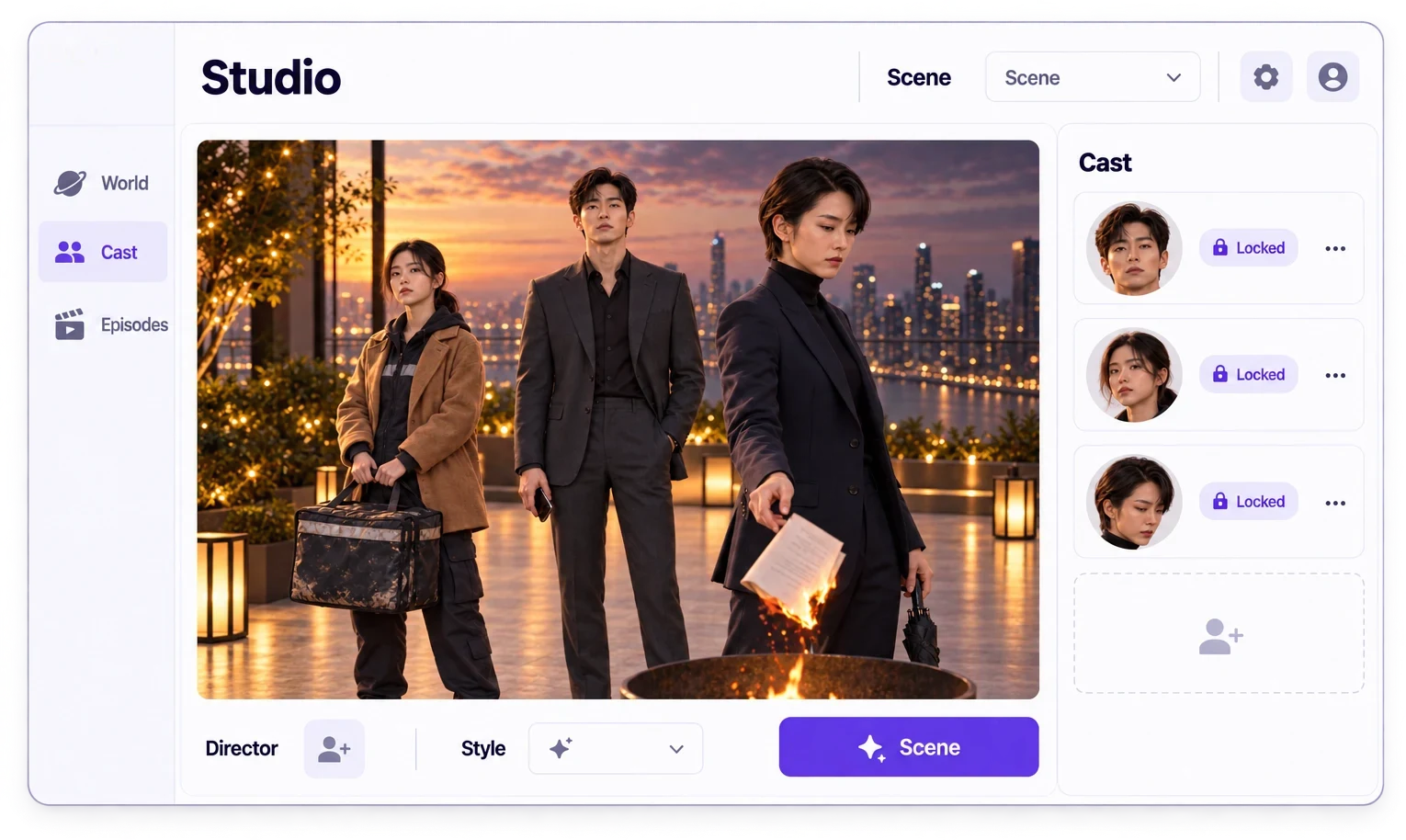

Your next Scene starts with you.
Make something you’ve always wanted to be in.
TRY THIS